
Pennsylvania Traffic Court Records
Pennsylvania traffic court records are public documents held by Magisterial District Courts across all 67 counties, the Philadelphia Municipal Court Traffic Division, and the Pittsburgh Municipal Court. These records cover traffic citations, case outcomes, fines, and court dates for violations of the Pennsylvania Vehicle Code. You can search traffic court records online through the UJS Portal, request driver records from PennDOT, or visit a local court in person. This guide covers each method for finding and accessing traffic cases in Pennsylvania.
Pennsylvania Traffic Court Records Quick Facts
Pennsylvania Traffic Court System Overview
Pennsylvania uses a multi-level court system to handle traffic cases. Most traffic citations go before a Magisterial District Judge (MDJ). These judges operate in local district courts spread across all 67 counties. Under 42 Pa.C.S. Section 1515, Magisterial District Judges hold jurisdiction over summary offenses, which include most traffic violations under Title 75 of the Pennsylvania Vehicle Code. Each district court keeps its own traffic records and docket sheets, which feed into the statewide UJS database.
Two cities operate their own specialized traffic courts. Philadelphia uses the Philadelphia Municipal Court Traffic Division, which took over from the old Philadelphia Traffic Court after Act 17 of 2013. Pittsburgh operates the Pittsburgh Municipal Court Traffic Division within Allegheny County. Both divisions handle a large volume of traffic cases each year and maintain public records that you can search online or review at the courthouse. Courts of Common Pleas stand above these courts in the hierarchy and hear all appeals from lower court decisions in traffic matters.
The Pennsylvania Courts website describes the system well. Traffic cases move through summary proceedings, which are simpler and faster than full trials. A docket sheet is created for each case. That sheet lists all filings, hearing dates, fines, and the final outcome. These docket sheets form the core of what most people call Pennsylvania traffic court records.
The official Pennsylvania Courts site confirms that public court information is accessible through the main portal without a login. The system covers appellate courts, common pleas courts, and all Magisterial District Court dockets. Recent entries may not appear immediately, so for time-sensitive searches, contacting the court directly is advised.
Search Pennsylvania Traffic Records Online
The fastest way to find Pennsylvania traffic court records is through the UJS Portal. The portal gives free access to docket sheets for Magisterial District Courts and Courts of Common Pleas across the entire state. You can search by case number, party name, offense tracking number, police complaint number, or state ID number. No login is needed for basic public searches.
Visit ujsportal.pacourts.us to start a search. The new Case Search screen consolidates docket searches across all court levels, showing docket sheet information and case calendar details in one place. A docket sheet is a record of court actions and filings on a case. It gives a summary of the case status but does not include downloadable copies of filed documents. To get actual documents, you need to contact the county clerk or Prothonotary where the case was filed.
The Pennsylvania Judiciary Web Portal also hosts a direct Case Search tool for searching across all court levels. This tool is tied to the PAePay payment system, which lets you pay traffic fines and court costs online by credit card or electronic check. Payment plans may be available for some cases. Payments post to court records within 24 to 48 hours.
The screenshot below shows the UJS Portal homepage, where traffic case searches begin for courts across Pennsylvania.
The Pennsylvania Judiciary Web Portal serves as the central access point for public traffic court records statewide.
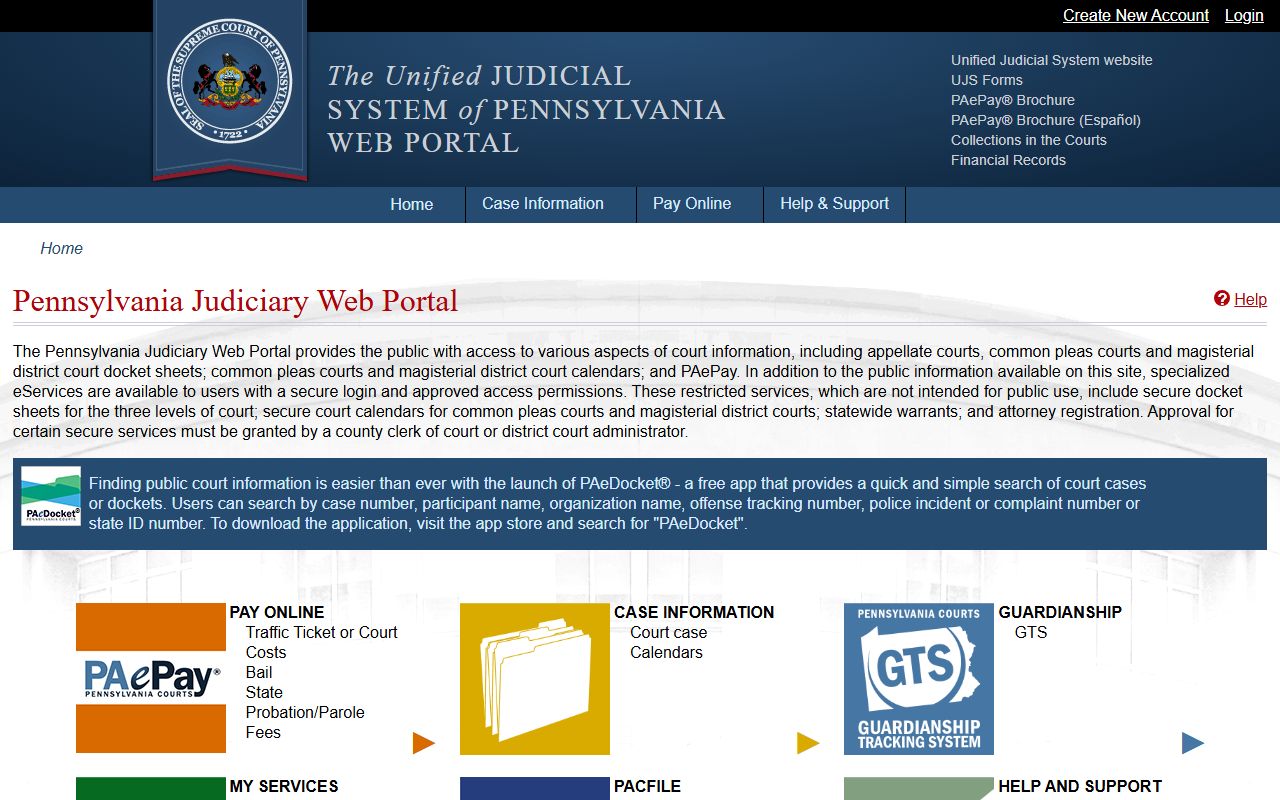
The UJS Portal home screen provides access to Magisterial District Court dockets, common pleas records, and the PAePay citation payment system for Pennsylvania traffic cases.
The PAeDocket mobile app extends this access to phones and tablets. You can download it from the Apple Store or Google Play. It lets you search by case number, participant name, or offense tracking number from anywhere in Pennsylvania.
Note: Docket sheet data from the UJS Portal should not be used as a substitute for a certified criminal history record, which only the Pennsylvania State Police can provide.
PennDOT Driver Records and Traffic History
PennDOT maintains a separate record system for driver histories. These records include traffic violations, license suspensions, points, and convictions. They are different from court docket sheets and come directly from PennDOT's Bureau of Driver Licensing. Requesting a driver record is useful when you need a full picture of traffic violations tied to a specific license over time.
The PennDOT Public Records FAQ page explains your options clearly. You can request a three-year, ten-year, or full driver history. Basic records cost $15.00 each through PennDOT's online system or by submitting Form DL-503 by mail. A certified driver record costs $47.00. Certified copies are only available by mail using Form DL-503, not online. The mailing address for requests is Bureau of Driver Licensing, Driver Record Services, P.O. Box 68695, Harrisburg, PA 17106-8695.
The screenshot below is from PennDOT's public records FAQ page, which outlines how to request Pennsylvania driver records related to traffic violations.
The PennDOT Driver and Vehicle Services FAQ page covers all common questions about requesting public records from PennDOT's Bureau of Driver Licensing.
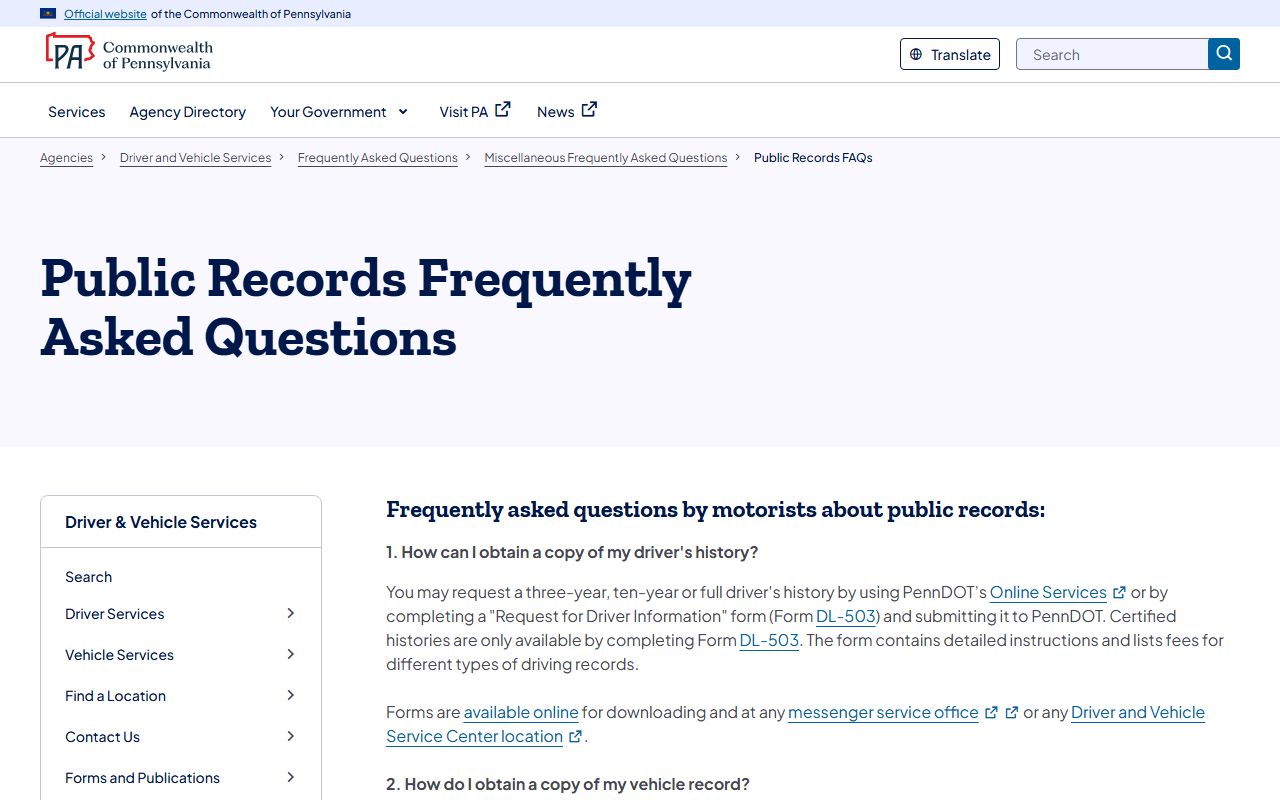
The PennDOT FAQ page covers how to request three-year, ten-year, and full driver histories, including system requirements for downloading records from the online service.
For online access, visit PennDOT's Individual Driver Records portal. This service lets Pennsylvania drivers download and print their own driver record. Records must be printed right away since they cannot be saved or emailed. Adobe Reader version 9 or higher is required to view the PDF. Technical support is available at PennDOT's Customer Call Center: 717-412-5300.
The screenshot below shows PennDOT's online driver record request system, where Pennsylvania drivers can purchase and download their own traffic history.
The Individual Driver Records portal at appsca.pwp.pa.gov/idr provides instant access to Pennsylvania driver records for a $15.00 fee.
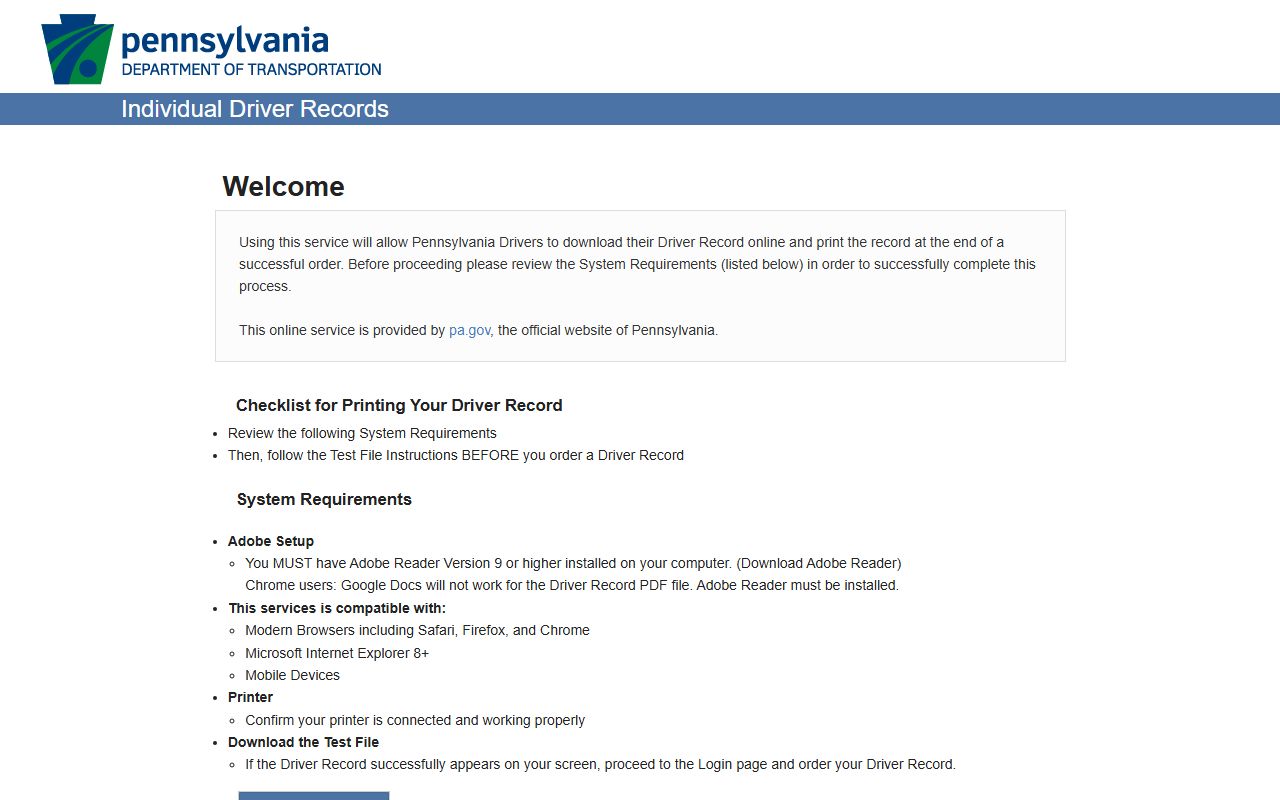
The PennDOT online portal allows drivers to choose from a three-year, ten-year, or full history, with records available for immediate download and printing after payment.
Philadelphia Traffic Court Records
Philadelphia handles traffic cases through its own dedicated division. The Philadelphia Municipal Court Traffic Division is the successor to the former Philadelphia Traffic Court, which was abolished by Act 17 of 2013. It is located at 800 Spring Garden Street, Philadelphia, PA 19130. Office hours are Monday through Friday, 8:30 a.m. to 7:30 p.m. The division hears moving violation citations only. Parking tickets are handled separately by the Philadelphia Parking Authority at 215-561-3636.
The Traffic Division handles over 250,000 cases each year. Case information is available through the UJS Portal. Court files are open for public inspection during business hours at the Spring Garden Street location. Fees apply for document copies. Appeals from the Traffic Division go to the Court of Common Pleas and must be filed in writing within 30 days of the final order, with a $35.00 filing fee per citation.
The screenshot below shows the Philadelphia Municipal Court Traffic Division homepage, which serves as the primary access point for traffic case information in Philadelphia.
The Philadelphia Municipal Court Traffic Division site provides case lookup information, hearing schedules, and payment options for Philadelphia traffic violations.
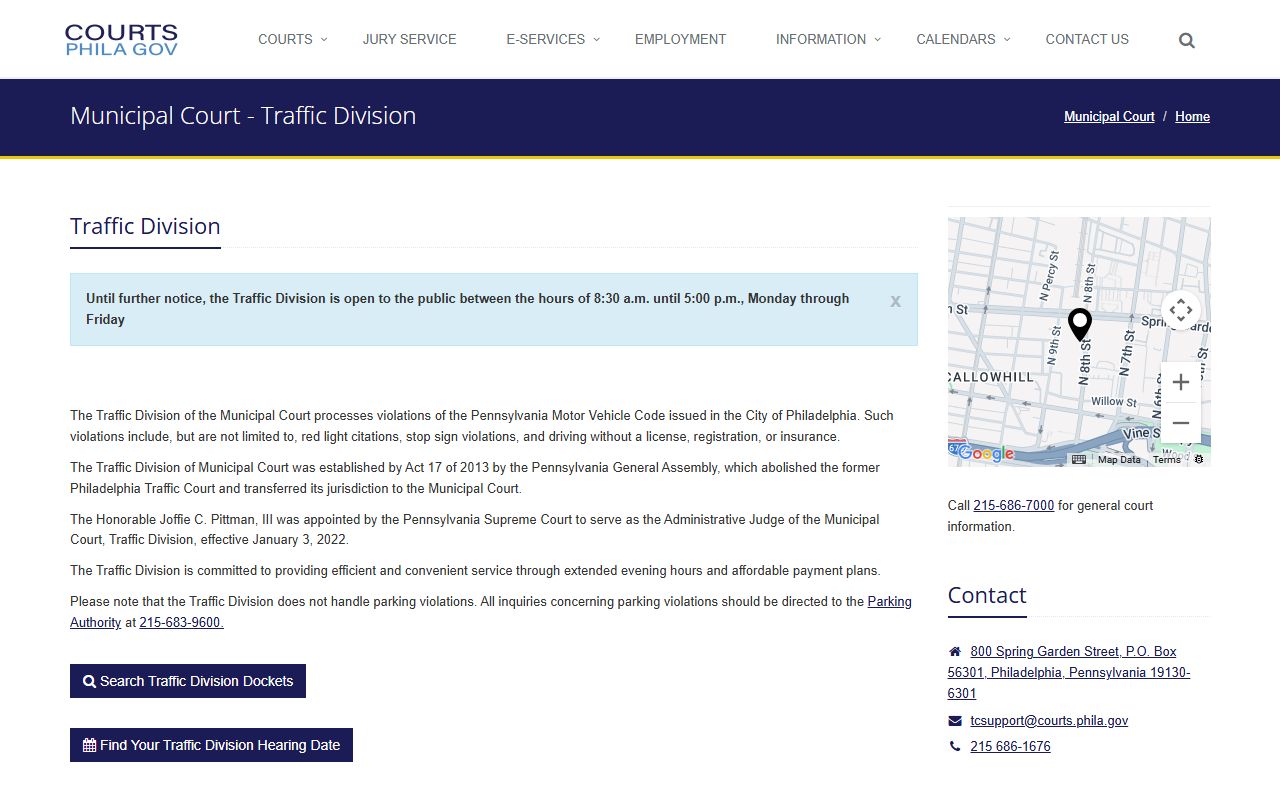
The Philadelphia Traffic Division page shows how to look up cases, pay citations online via PAePay, and access public traffic records for the city of Philadelphia.
Note: If you fail to appear at a scheduled Philadelphia Traffic Division hearing, a trial will be held in your absence and a verdict entered without you present.
Pittsburgh Municipal Court Traffic Division
Pittsburgh traffic violations are handled by the Pittsburgh Municipal Court Traffic Division, which is part of the Allegheny County court system. The court is located at the Municipal Courts Building, 660 First Avenue, Pittsburgh, PA 15219. Traffic Division hours run Monday through Friday, 8:00 a.m. to 4:30 p.m. The Traffic Division phone number is 412.350.6720. Emergency hearings and arraignment court run 24 hours a day.
Magisterial District Judges preside over more than 70,000 cases each year at Pittsburgh Municipal Court. The court's jurisdiction covers traffic offenses within Pittsburgh city limits, excluding Pittsburgh Parking Authority citations and regular parking tickets. It also covers non-traffic summary offenses and violations of City of Pittsburgh ordinances. Preliminary hearings on misdemeanor and felony cases are heard here as well.
The screenshot below shows the Pittsburgh Municipal Court about page on the Allegheny County Courts website, which lists jurisdiction, hours, and contact information for the Traffic Division.
You can learn more about Pittsburgh Municipal Court jurisdiction and traffic case procedures at the Allegheny County Courts Pittsburgh Municipal Court page.
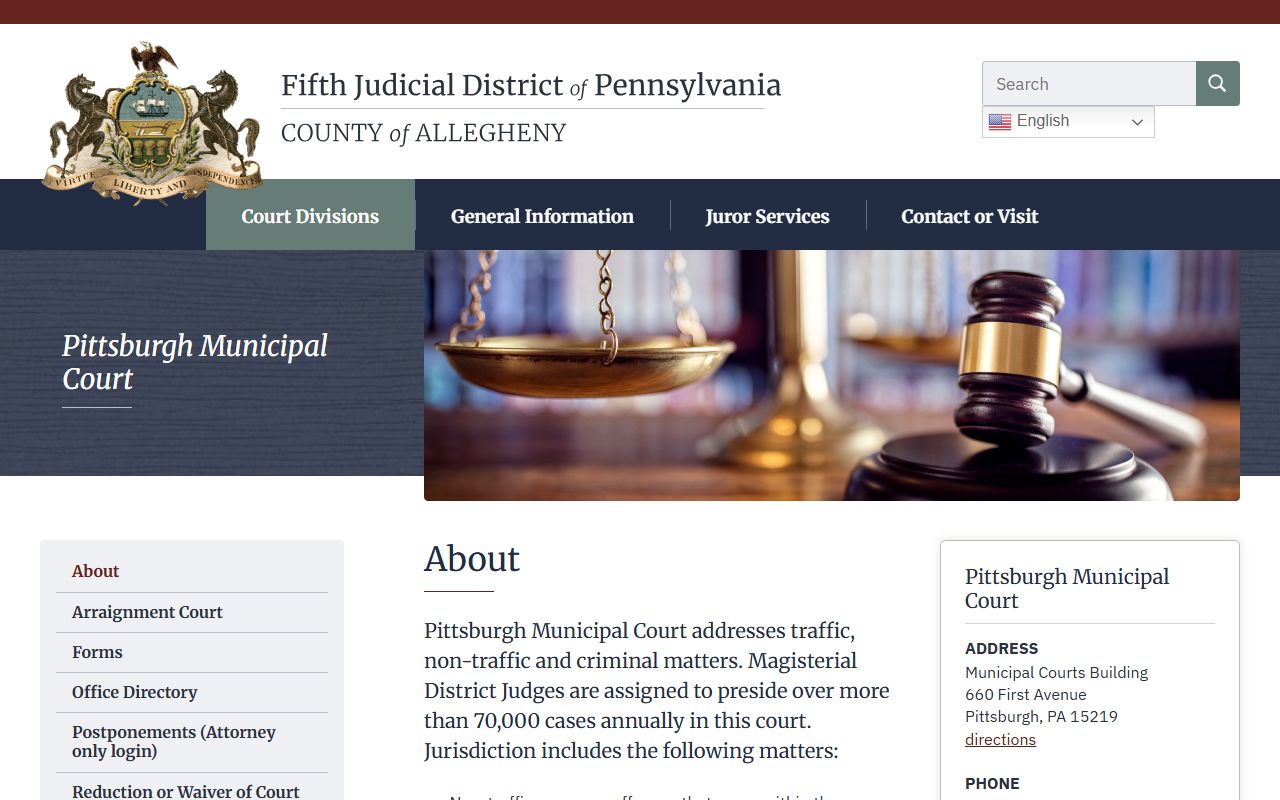
The Allegheny County Courts website lists Pittsburgh Municipal Court's jurisdiction, which includes traffic offenses within Pittsburgh city limits as well as non-traffic summary matters and preliminary hearings.
What Pennsylvania Traffic Court Records Contain
A traffic court docket sheet is the standard document you get when searching for a case. It lists the defendant's name, the charges filed, the offense date, the citation number, the hearing dates, and the final disposition. It also shows any fines imposed, fees assessed, and whether the defendant appeared or was tried in absentia. The docket sheet gives a full timeline of the case from the initial citation through the final order.
Traffic docket sheets for Magisterial District Courts also show the name of the issuing officer and the police agency. If a case was appealed to the Court of Common Pleas, the docket sheet notes the appeal filing date and outcome. Each entry is timestamped with when it was added to the court system. This makes it easy to trace the full history of a traffic case from the initial stop through resolution.
Court docket sheets are available for free through the UJS Portal. Printed copies of documents from the case file require a fee. Reasonable copy fees apply at both the Magisterial District Court level and at the Philadelphia and Pittsburgh divisions. Under 234 Pa. Code Rule 1002, the court file is available for public inspection and copying.
The screenshot below shows the Pennsylvania Code page for Rule 1002, which governs procedures in summary cases including traffic violations handled by the Philadelphia Municipal Court Traffic Division.
The full text of 234 Pa. Code Rule 1002 covers procedures for summary cases, including traffic citations and the rights of defendants in traffic proceedings.
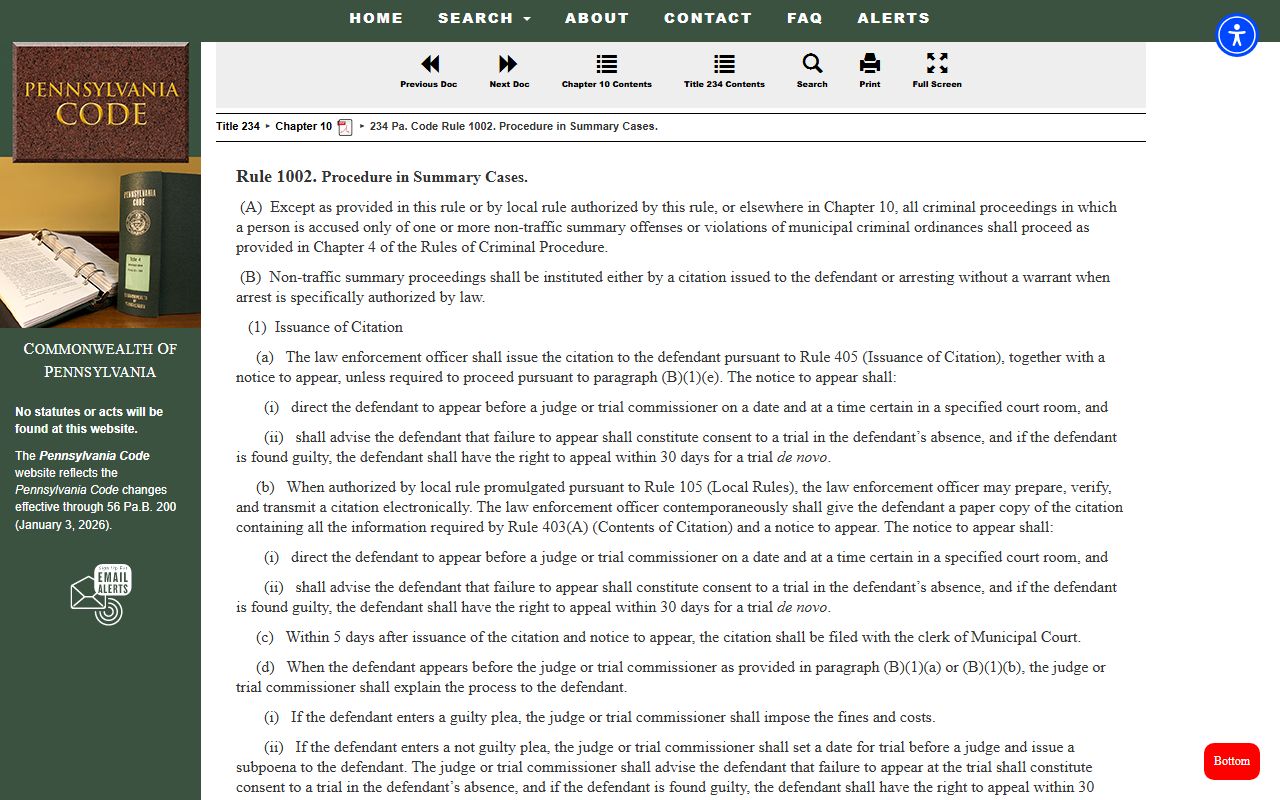
Pennsylvania Code Rule 1002 establishes how traffic summary cases are processed, including hearing procedures, appearance requirements, and appeal rights for traffic violations in Philadelphia and statewide.
Pennsylvania Traffic Laws and Statutes
Several key statutes shape how Pennsylvania traffic court records are created and kept. Understanding these laws helps when reading a docket or deciding whether to appeal a citation.
Under 42 Pa.C.S. Section 1302, traffic courts have jurisdiction over all prosecutions for summary offenses arising under Title 75, which is the Pennsylvania Vehicle Code. This statute also extends jurisdiction to local ordinances that regulate vehicle operation on streets, highways, and bridges. Section 1302 is the foundational law that defines the reach of traffic courts in Pennsylvania.
The screenshot below shows the Justia page for Section 1302, which establishes statutory jurisdiction for Pennsylvania traffic courts over Title 75 violations.
The text of 42 Pa.C.S. Section 1302 defines the jurisdiction of traffic courts over all summary offenses arising under the Pennsylvania Vehicle Code.
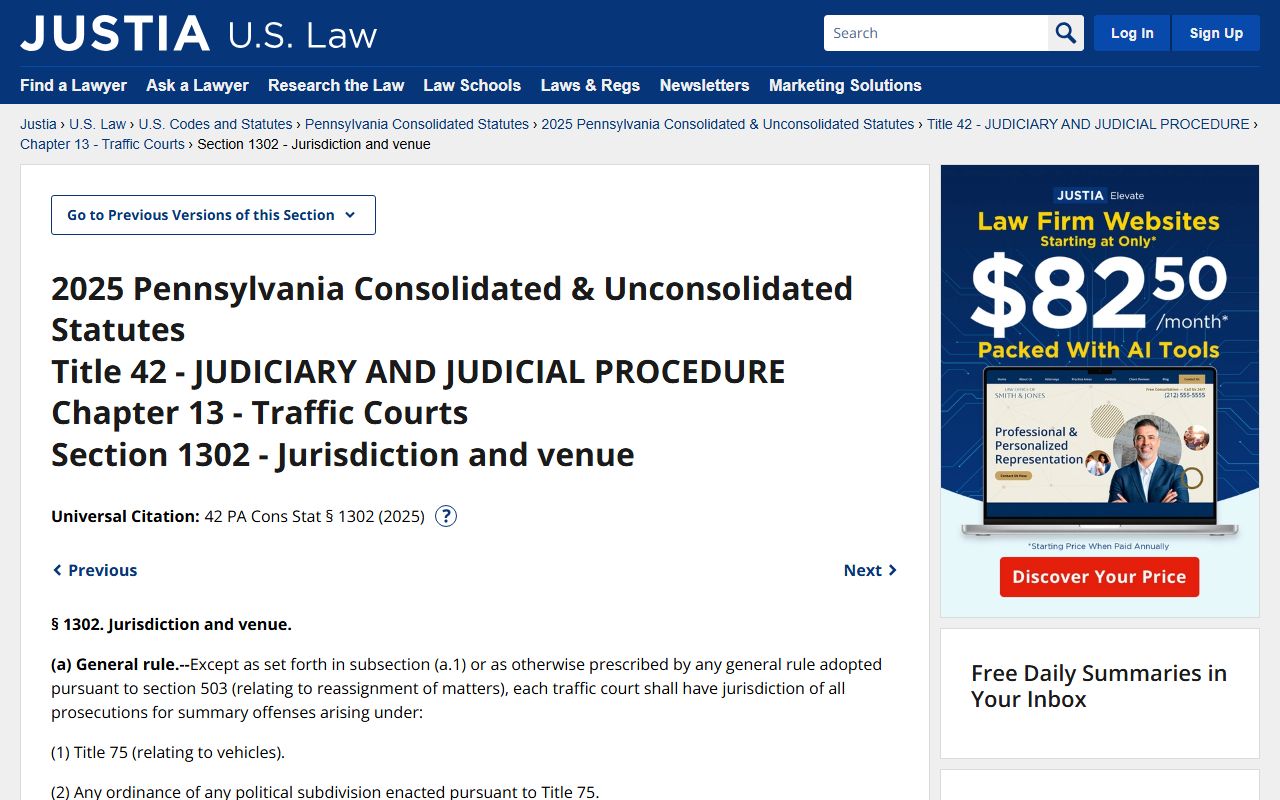
Section 1302 establishes that traffic courts hold authority over all Title 75 prosecutions, including both state vehicle code violations and local traffic ordinances throughout Pennsylvania.
Title 75 of the Pennsylvania Consolidated Statutes is the Vehicle Code itself. It covers all traffic laws and regulations in the state. Chapter 31 covers general traffic rules. Chapter 33 covers the rules of the road. Chapter 38 covers driving under the influence. Chapter 41 covers traffic violations and penalties. The full Vehicle Code is available through Westlaw's Pennsylvania Statutes database.
The screenshot below shows the Westlaw Pennsylvania Statutes database, where the full text of the Pennsylvania Vehicle Code and related traffic laws can be found.
Westlaw hosts Unofficial Purdon's Pennsylvania Statutes, including Title 75 which governs all traffic laws and the violations that generate traffic court records in Pennsylvania.
The Westlaw Pennsylvania Statutes page provides access to Title 75 chapters covering speed limits, rules of the road, DUI, traffic penalties, and license suspension, all of which generate traffic court records in Pennsylvania.
Pennsylvania Traffic Records Public Access Policy
Pennsylvania traffic court records are public under the state's public access policy for the Unified Judicial System. The Administrative Office of Pennsylvania Courts (AOPC) published the original Public Access Policy for Magisterial District Courts, which became effective July 1, 2010. The policy was issued under authority of 42 Pa.C.S. Section 4301(b) and is found in the Pennsylvania Bulletin. It applies to official case records held by Magisterial District Courts across Pennsylvania.
The screenshot below shows the Pennsylvania Bulletin page where the original AOPC public access policy for Magisterial District Court records was published in 2010.
The AOPC Public Access Policy in the Pennsylvania Bulletin governs how Magisterial District Court records, including traffic dockets, are made available to the public under the Unified Judicial System.
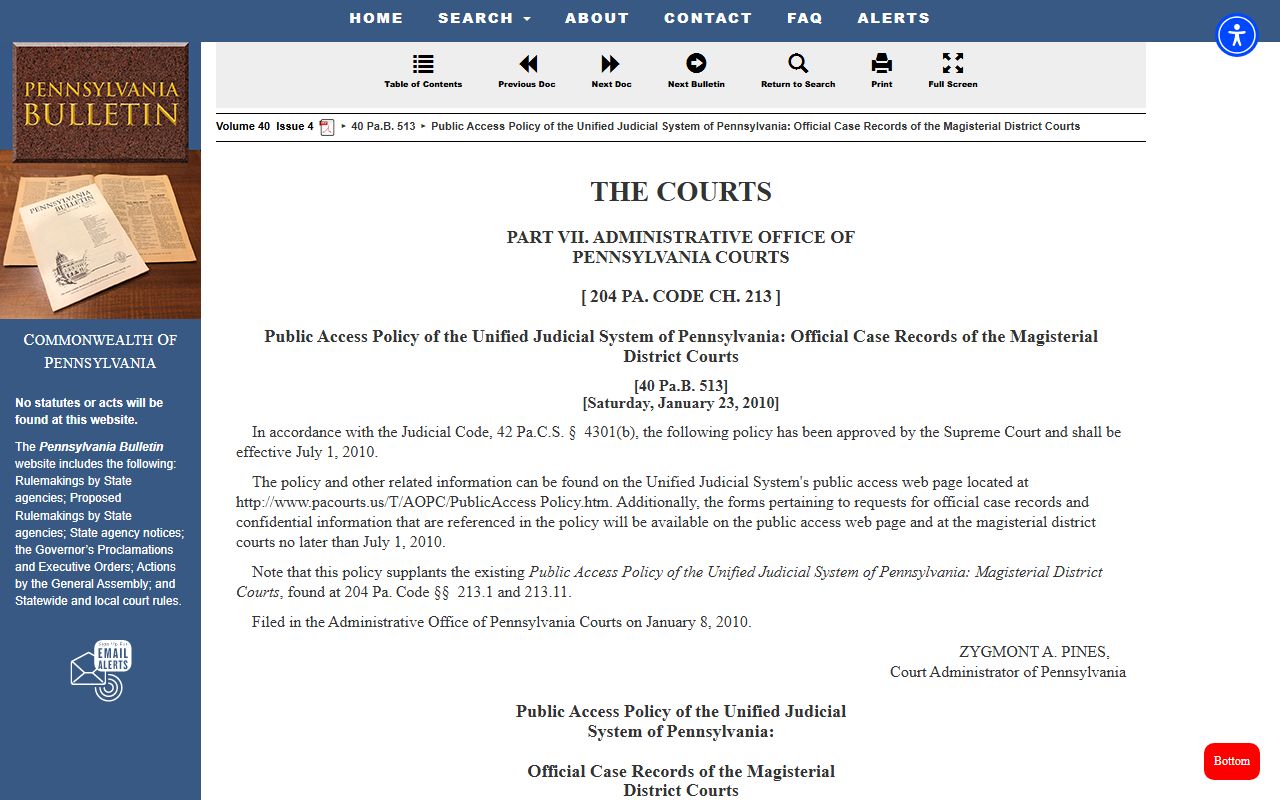
The Pennsylvania Bulletin entry for the AOPC public access policy details the rules for accessing official case records, including traffic citations and docket sheets, at Magisterial District Courts statewide.
The Pennsylvania Supreme Court amended the Case Records Public Access Policy effective January 1, 2022. Under the amended policy, sensitive information such as Social Security numbers and financial account numbers must be redacted from public versions of documents. Filing parties are responsible for submitting a separate Confidential Information Form when documents contain restricted data. This change affects how traffic court records look when you request copies, since personal identifiers may be removed from public copies.
The screenshot below shows the Allegheny County Courts page explaining how the January 2022 amendments to the public access policy changed confidential information filing requirements.
Allegheny County Courts published detailed guidance on the amended policy at the Allegheny County public access policy page, which covers how redaction requirements apply to traffic case filings and other court records.
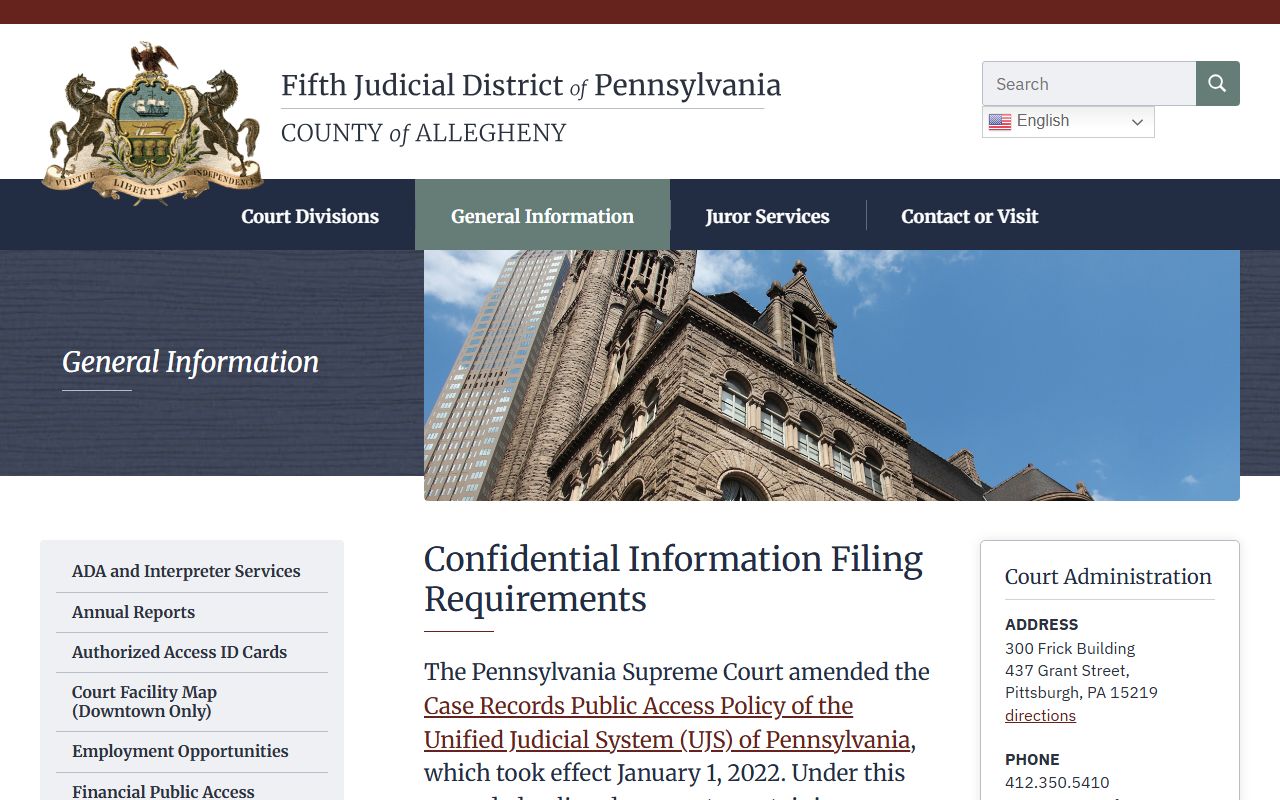
The Allegheny County Courts page describes how attorneys and self-represented parties must now use a Confidential Information Form to separate sensitive data from publicly accessible traffic court documents under the 2022 policy amendment.
Note: Government agencies may receive some information from traffic records that is restricted from general public access, including Social Security numbers, driver license numbers, and dates of birth, under the AOPC public access policy.
Pennsylvania Courts and Traffic Case Dockets
The official Pennsylvania Courts website at pacourts.us serves as the hub for all public court information in the state. It links to the UJS Portal case search, PAePay for online payments, and public records information. The site explains how docket sheets work and where to find documents that are not available for download online.
The screenshot below shows the official Pennsylvania Courts homepage, which provides links to case search tools, PAePay, and public records guidance for traffic cases statewide.
Visit the Pennsylvania Courts official website for links to case search, PAePay online payments, and public records policies covering traffic court records across all 67 Pennsylvania counties.
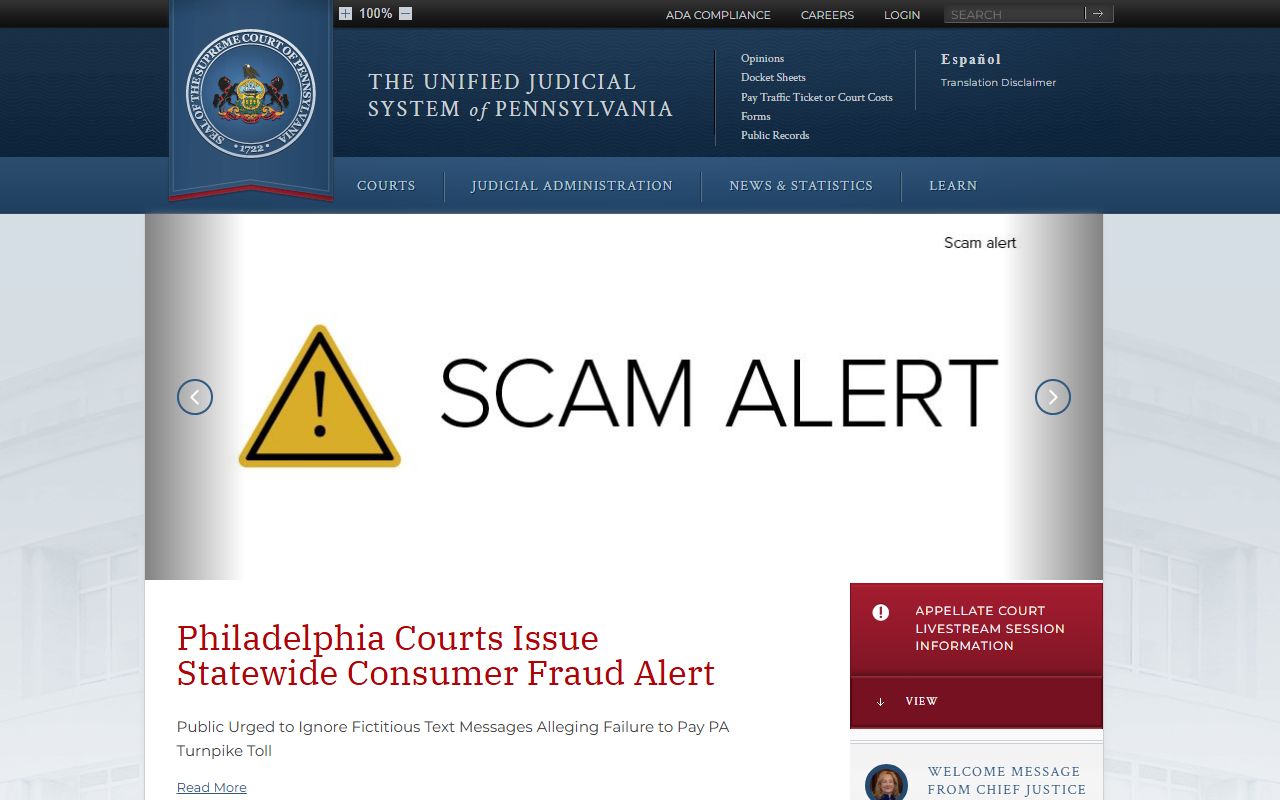
The Pennsylvania Courts homepage directs users to the UJS Portal case search, PAePay citation payment system, and public records resources covering traffic court records at every level of the Pennsylvania court system.
The PAePay system referenced on the Courts website allows online payment of traffic citations and court costs. You can search by citation number, docket number, or name before paying. Payments are made by credit card or electronic check. A convenience fee applies to online transactions. You can also search for cases and view docket information through the same interface at ujsportal.pacourts.us/CaseSearch.
The screenshot below shows the PAePay case search interface, used for both looking up traffic cases and making online payments on Pennsylvania traffic citations.
The UJS Case Search and PAePay portal provides a single screen for finding traffic dockets and paying outstanding citations across Pennsylvania's court system.
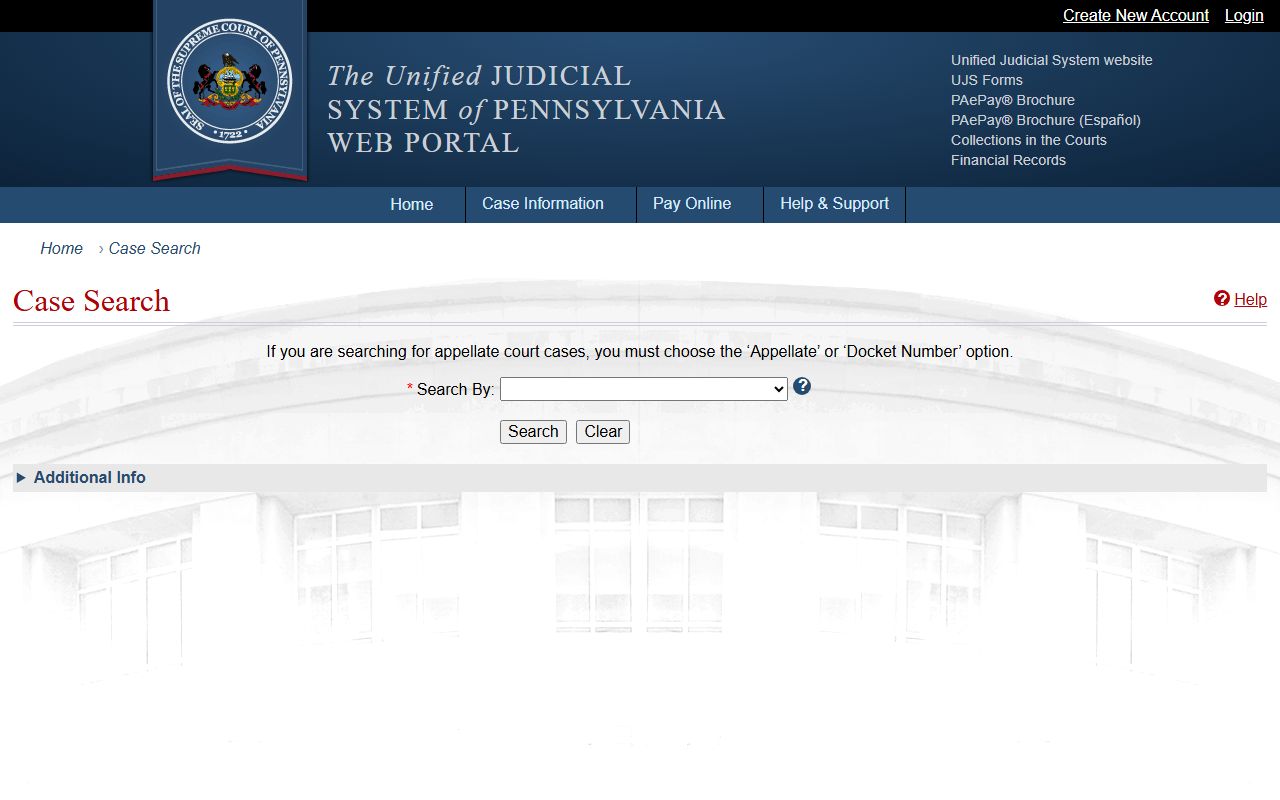
The PAePay interface lets users search for traffic cases by citation or docket number, view case status, and submit online payments for outstanding fines on Pennsylvania traffic violations.
Appealing a Pennsylvania Traffic Court Decision
Any defendant who is convicted in a summary traffic case has the right to appeal. Appeals go to the Court of Common Pleas in the county where the case was heard. You must file the appeal in writing within 30 days of the final order. The filing fee is $35.00 per citation. This applies to appeals from Magisterial District Courts and from the Philadelphia Municipal Court Traffic Division under 234 Pa. Code Rule 1002.
An appeal to the Court of Common Pleas is a trial de novo, which means the case starts over. The law enforcement officer who originally issued the citation must appear and testify at the appeal hearing. If the officer does not appear, the charges are dismissed unless the defendant waives that requirement. This rule gives defendants a real opportunity to contest their traffic violations at a higher court level in Pennsylvania.
If you miss the 30-day deadline, you may file a Nunc Pro Tunc petition asking the court to allow a late appeal. The fee for that petition is $12.50. Courts grant these only when there is a good reason for the delay. Late appeals are not guaranteed in Pennsylvania.
Other key court fees for traffic cases include a $15.50 filing fee for a Title 75 summary traffic citation at the Magisterial District Court level. These fees are set by the court system and may vary slightly by county.
Note: If you miss your hearing date in a summary traffic case, a trial will be held in your absence and a verdict can be entered without you, so check your docket through the UJS Portal to stay current on hearing dates.
Browse Pennsylvania Traffic Court Records by County
Each of Pennsylvania's 67 counties has Magisterial District Courts that handle traffic citations and keep local traffic records. Select a county below to find traffic court resources for that area.
Traffic Court Records in Major Pennsylvania Cities
Major Pennsylvania cities have their own traffic courts or Magisterial District Courts serving the local area. Select a city to find traffic court record resources near you.